

Why Your Subconscious Mind Holds the Key to Your Inner World
Explore your subconscious mind and you’ll find a vast landscape beneath your everyday awareness—one that shapes your decisions, emotions, creativity, and sense of self.
To explore your subconscious mind effectively:
- Understand the landscape – Recognize that your conscious mind processes only 50 bits of information per second, while your subconscious handles 11 million bits per second
- Practice attentive stillness – Use mindfulness, body scans, and observation to notice patterns below your awareness
- Keep a journal – Write freely to surface hidden beliefs, emotions, and recurring thoughts
- Work with your dreams – Record and reflect on dream imagery as symbolic communication from your depths
- Reframe limiting beliefs – Identify unconscious patterns and gently reshape them through new associations
- Use symbolic reminders – Create environmental cues that reinforce your evolving self-image
Your subconscious is like an iceberg. The conscious mind—what you’re aware of right now—is the visible tip above water. But beneath the surface lies something far more vast: your subconscious and unconscious mind, containing stored memories, automatic functions, beliefs formed in childhood, creative associations, and emotional patterns that influence every choice you make.
Scientists have found that your subconscious mind makes decisions up to 10 seconds before you’re consciously aware of them. This isn’t a threat to your autonomy. It’s an invitation.
The work isn’t about wrestling control from some hidden force. It’s about listening. About building a relationship with the parts of yourself that operate in silence. About understanding that 90-95% of your behavior is guided by this deeper intelligence.
This is not mysticism. It’s the architecture of how you actually work.
The journey to explore your subconscious mind begins with a shift in posture—from conquest to curiosity, from fixing to befriending. The landscape within you is already there, already speaking. The question is whether you’re willing to listen.
Mapping the Inner World: Conscious, Subconscious, and Unconscious
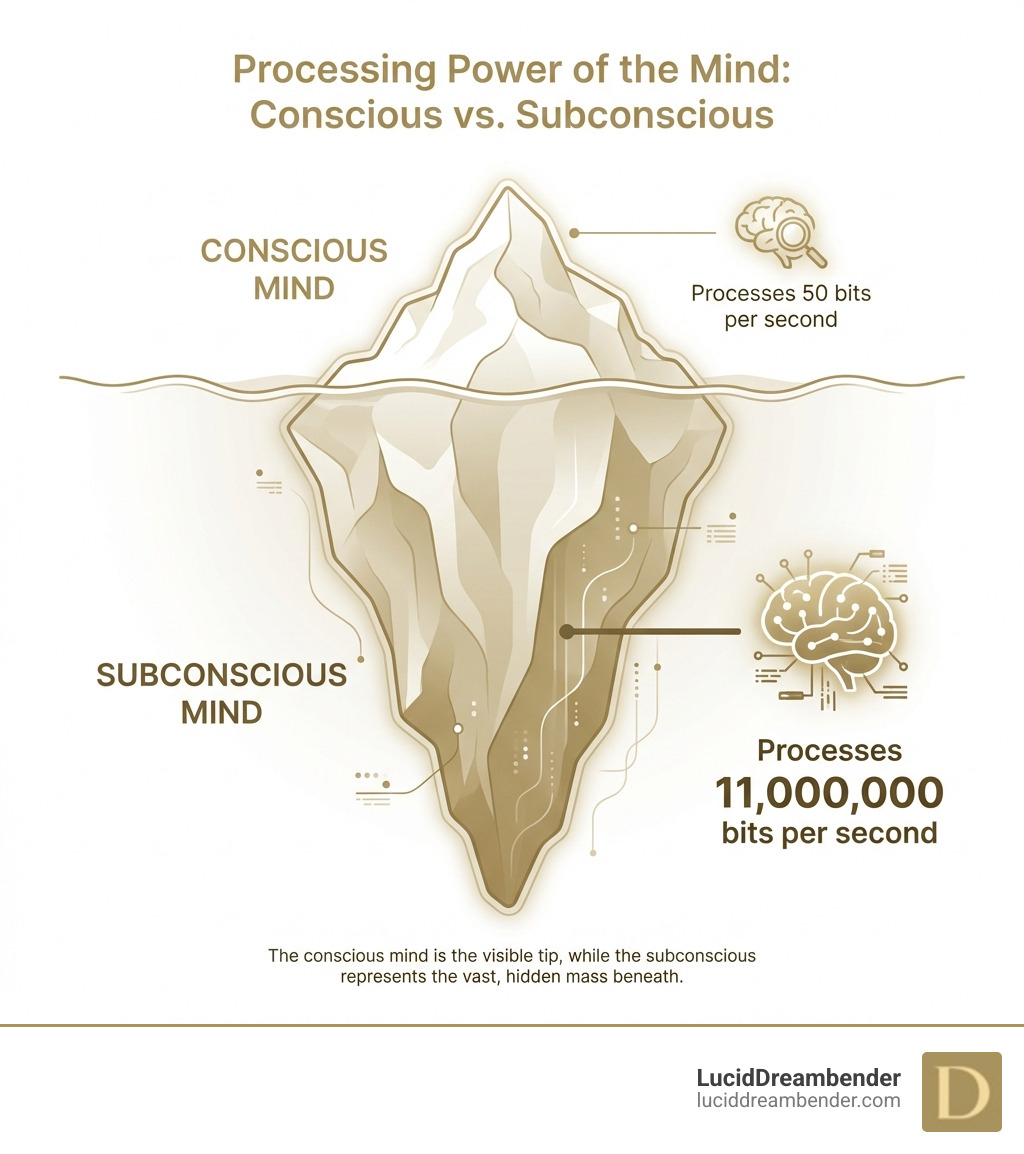
To explore your subconscious mind, we must first map its territories. Freud’s iceberg theory offers a powerful analogy: the conscious mind is the visible tip, while the subconscious and unconscious form the immense, hidden mass below.
Our mind is a complex interplay of processing centers. The conscious mind, our “attentive captain,” steers the present, processing about 50 bits of information per second with willpower and logic. Beneath this surface, a vaster operation is underway.
The subconscious and unconscious fields handle the vast majority of our mental activity, processing an astonishing 11 million bits per second. This includes autonomic functions like breathing and heartbeat, as well as stored memories and ingrained habits that influence our thoughts, emotions, and behaviors.
Consider the mind-body connection. Past experiences, especially those with strong emotion, become embedded as “emotional memories.” These manifest as physical patterns, influencing everything from posture to automatic reactions. Persistent anxiety, for example, might unconsciously create tense shoulders or shallow breathing. Recognizing this is key to understanding how our inner world shapes our outer reality.
The Default Mode Network (DMN), a brain network active during relaxation, is crucial for creativity. This is where the subconscious connects disparate ideas, leading to “aha!” moments during a shower or a walk.
Furthermore, our subconscious is deeply involved in decision-making. Scientific findings reveal that decisions can be made by the subconscious up to 10 seconds before our conscious mind registers them. This highlights the influence of our underlying patterns. Intuition, or a “gut feeling,” is another power of the subconscious—a rapid pattern-recognition system that guides us through complex situations.
The Conscious Mind: The Attentive Captain
Our conscious mind is our focal awareness—the rational, present-moment part that plans, analyzes, and exerts willpower. It’s the voice in our head that processes new information and makes deliberate choices.
While essential, the conscious mind has a limited processing capacity of about 50 bits per second. This means much of what influences us operates “below the radar.” It’s the captain on the bridge, but the vast machinery below deck is handled by a much larger, unseen crew.
The Subconscious & Unconscious: The Vast, Silent Crew
The terms “subconscious” and “unconscious” are often used interchangeably, though they have distinct roots. Early psychology used “subconscious” to describe awareness beneath conscious thought. Freud later preferred “unconscious” for the deeply hidden, repressed desires and memories influencing our behavior. Jung expanded this with his concept of the “collective unconscious,” an inherited library of universal archetypes.
Modern neuroscience supports the existence of processes operating outside conscious awareness. This “modern unconscious” is seen as an efficient, adaptive system. It handles automatic functions, manages long-term memory, and underpins habit formation.
The subconscious is the silent crew running our lives. It stores our experiences, beliefs, and learned patterns, influencing 90-95% of our daily behavior. It’s the wellspring of creativity and intuition, constantly at work shaping who we are.
Practices of Attention: How to Explore Your Subconscious Mind

To explore your subconscious mind is not to control it, but to cultivate a relationship of dialogue and receptivity. It’s about moving from thinking about your inner world to listening to it. This requires grounded exercises that invite insight, allowing us to understand the nuanced language of our inner landscape.
Attentive Stillness: Mindfulness and Observation
Mindfulness is a foundational practice for connecting with your deeper self. It means paying attention to the present moment without judgment. Through practices like body scan meditation, we can bring awareness to physical sensations, noticing tension or ease. This stillness allows us to observe thoughts and emotions as they arise without being swept away.
By simply observing, we create space for insight. We notice recurring patterns—the body’s reaction to stress, the mind’s loops of worry. This awareness feeds information to the unconscious, allowing it to re-evaluate old ways of being. It’s not rigid discipline, but a soft curiosity that invites the deeper mind to reveal itself.
The Reflective Mirror: Journaling for Clarity

Journaling is a reflective mirror, offering a direct channel to subconscious thoughts. When we write freely, without censor, we bypass the conscious mind’s filters and allow deeper insights to surface. This can take many forms:
- Automatic writing: Writing continuously for a set period, letting whatever comes to mind flow out.
- Dream journaling: Documenting dreams is a powerful way to engage with the subconscious. Even fragments or feelings are valuable. We recommend starting with the steps on how to remember dreams.
- Unsent letters: Writing letters to people about unresolved feelings can release emotional blockages and bring clarity.
Journaling is also an excellent tool for identifying limiting beliefs. By asking open-ended questions in your journal—like “What am I truly afraid of?”—we invite our subconscious to offer answers, bringing hidden patterns into the light.
The Art of Deep Listening
Deep listening is about discerning the unspoken emotions and symbolic meanings in communication. This applies both externally and internally.
When we listen deeply to others’ stories, we notice recurring themes and metaphors. People often convey core fears through narratives without being consciously aware of it. This skill helps us see patterns beneath the surface, understanding not just what is said, but what is truly felt.
This practice sharpens our ability to listen to our own inner dialogue. The subconscious often communicates through metaphors, images, and feelings. Paying attention to these cues helps us understand our unspoken needs and fears. Our internal narratives can reveal the limiting beliefs or past experiences holding us back. Learning to tell therapeutic stories, as practiced by Milton Erickson, can also encode problem-solving strategies, influencing our subconscious toward positive change.
The Language of the Depths: Dreams as a Gateway to the Subconscious
Dreams are perhaps the most direct and vivid communication we receive from our subconscious mind. They are not random neurological firings, but rather a rich mix of symbolic communication, emotional truths, and integrated experiences. While dreams do not offer literal predictions of the future, they provide profound insights into our inner world, reflecting our hopes, fears, unresolved conflicts, and creative potential.
Think of dreams as the mind’s nightly storytelling session, where the subconscious processes the day’s events, integrates new information, and explores various scenarios. Recurring dream themes, in particular, often point to persistent patterns or unresolved issues that our deeper mind is trying to bring to our attention. These aren’t puzzles to be solved in a linear fashion, but experiences to be felt and reflected upon, revealing emotional truths that conscious logic might bypass.
Our Dream Interpretation AI framework helps us engage with these symbolic communications, offering personalized insights rooted in psychological understanding. It’s a tool to help us explore the profound imagery and archetypal patterns that often appear in our dreams, guiding us towards deeper self-awareness.
How to Remember and Record Your Dreams
Many people feel they “don’t dream,” but the truth is everyone dreams. The challenge is often in remembering them. The key is intention and consistent practice:
- Set the intention: Before falling asleep, tell yourself that you want to remember your dreams. This simple act primes your subconscious to retain dream content.
- Keep a dream journal: Place a notebook and pen (or your phone for digital journaling) right beside your bed. This makes it easy to record dreams immediately upon waking.
- Wake slowly: Avoid jolting yourself awake with an alarm. Allow yourself to gently transition from sleep to waking, staying still for a few moments and letting dream fragments resurface.
- Capture fragments and feelings: Don’t worry about remembering the whole dream perfectly. Write down any images, words, emotions, or sensations that come to mind. Even a single word or feeling can serve as a hook to recall more later.
- Review your journal: Periodically reread your dream entries. You might start to notice patterns, recurring symbols, or themes that offer insights into your current life situation.
For more detailed guidance, we’ve outlined practical steps on how to remember dreams that can significantly improve your recall ability.
Working with Dream Imagery
Once we begin to remember our dreams, the next step is to engage with their imagery. This process is less about finding a definitive, “correct” interpretation and more about fostering a dialogue with our inner world. We encourage reflection rather than prescribing meaning, as the truest insights come from within you.
Instead of asking “What does this dream mean?”, try asking:
- “What does this image feel like to me?”
- “What emotions does this dream evoke?”
- “How does this dream relate to what’s happening in my waking life right now?”
- “If this dream image could speak, what would it say?”
Dreams communicate through the language of metaphor and symbol, often presenting aspects of ourselves or our experiences in a disguised form. Carl Jung’s work on archetypes highlights how universal symbols—like the Hero, the Shadow, or the Wise Old Man—can appear in our dreams, representing fundamental human experiences. Engaging with these symbols allows us to connect with deeper, collective patterns of meaning.
The dream is an experience, not a puzzle to be solved. Its value lies in the process of reflection and the insights it sparks, rather than a definitive answer. For those interested in deeper exploration, the benefits of lucid dreaming for self-exploration offer another powerful avenue, allowing for conscious interaction within the dreamscape itself.
From Insight to Integration: Reshaping Your Inner Landscape
The journey to explore your subconscious mind is about integrating insights to foster meaningful change. This is a gradual process of integration, not elimination. We don’t discard parts of ourselves, but seek to understand and incorporate them—even the rejected Jungian “Shadow.” This requires self-compassion, recognizing that our patterns often arose as protective mechanisms.
True self-empowerment follows the BE → DO → HAVE sequence. First, cultivate the desired being (the inner state). From that place, do the aligned actions. Finally, have the results that naturally flow. This is a powerful shift from the less effective DO → HAVE → BE approach.
How to Explore Your Subconscious Mind to Reframe Beliefs
One of the most transformative aspects of this work is reframing limiting beliefs. These are ingrained assumptions that operate below awareness. Reframing is a gentle technique to update these old patterns.
- Identify the Limiting Belief: Pinpoint a belief that holds you back, like “I’m not good enough.”
- Explore its Origin and Function: Ask: Where did this belief come from? What purpose did it serve? Understanding its roots allows for compassion, not judgment.
- The Reframing Technique: Consciously alter the belief’s meaning. For example, reframe “I’m too lazy” as “I take my time to make thoughtful decisions.” This linguistic tool offers a new, empowering perspective.
- Create a Compelling Self-Image: Visualize yourself embodying the opposite of the limiting belief. What does this new “you” look, feel, and act like?
- Associate New Feelings with the New Image: Engage all your senses. See, hear, and most importantly, feel the emotions of this new self. Integrating this image helps ensure it’s supported by your inner architecture, guiding your actions.
This process updates the internal “images” our subconscious holds about who we are, fostering authentic self-esteem.
Using Symbolic Reminders for Lasting Change
Our subconscious is highly receptive to symbols and environmental cues. We can use this by placing strategic reminders in our environment.
- Treasure Mapping (Vision Boards): Create a visual collage of images and words representing your goals and the feelings of achieving them. Place it where you’ll see it daily to consistently feed your subconscious positive affirmations.
- Environmental Cues: Simple reminders can act as powerful nudges. Leaving your journal open on your desk encourages a writing practice. Wayne Dyer famously drew his book covers and kept them visible as motivation.
- The Practice of ‘Memento Mori’: A reminder of mortality can be a profound motivator. Reflecting on the finite nature of life can influence our subconscious to prioritize what truly matters. Research has demonstrated the positive psychological effects of mortality reminders, leading to greater purpose. Choose a symbolic object and reflect on it daily.
These symbolic reminders act as anchors, programming our subconscious to align with our conscious intentions, making change feel more natural.
Frequently Asked Questions about Exploring the Subconscious
What is the difference between the ‘subconscious’ and the ‘unconscious’ mind?
Though often used interchangeably, these terms have distinct psychological meanings.
- ‘Unconscious’ was Freud’s term for the reservoir of repressed thoughts, desires, and memories that influence behavior and are largely inaccessible.
- ‘Subconscious’ is a more popular term for mental processes just below awareness, like habits and automatic thoughts.
- Modern View: Today, both terms broadly refer to mental activity outside conscious awareness. We use them to acknowledge the vast, non-conscious layers of the mind.
Can exploring my subconscious predict the future or give medical advice?
No. The subconscious is insightful but not psychic. It cannot predict the future. Its wisdom comes from its vast memory of past experiences and patterns, not supernatural foresight. Its goal is to help you steer the present, not foretell what will happen.
Similarly, while exploring the mind-body connection can offer insights, it is not a substitute for professional medical advice. If you have health concerns, always consult a qualified physician. This work is for self-reflection, not diagnosis or treatment.
Is it safe to explore these deeper parts of the mind?
Yes, this exploration is generally safe when approached with curiosity and self-compassion. Your mind has protective mechanisms and may withhold information until you are ready. The process is about gentle listening, not forced excavation.
However, if you have experienced significant trauma, this work might bring up intense emotions. In such cases, we strongly advise seeking support from a qualified mental health professional. A therapist can provide a safe, guided environment to process challenging material.
The Journey Continues
To explore your subconscious mind is to start on the ultimate adventure—an inward journey that promises profound self-findy. It is not about taming a wild beast, but rather about befriending a vast, intelligent landscape that has always been a part of you. This is a lifelong relationship of listening, learning, and integration.
The Dreambender framework offers a guide for this exploration, emphasizing clarity, emotional resonance, and grounded practices. We invite you to cultivate a posture of curiosity, allowing the subtle language of your dreams, thoughts, and feelings to reveal its wisdom.
The journey inward is not just an intellectual exercise; it is an embodied experience that reshapes your perception, improves your creativity, and deepens your connection to your authentic self. As you continue to listen to the whispers from your depths, you will find yourself more aligned, more present, and more capable of navigating the complexities of life.
To begin actively engaging with this powerful inner landscape, we invite you to learn the foundational practice of how to lucid dream and open another profound pathway to your subconscious mind.